

Start Living Comfortably and Find Relief From Acid Reflux Diseases
Almost all of us experience reflux from time to time, mostly as heartburn. The condition is caused when stomach contents move back up into the esophagus, or the food tube. When these acidic stomach contents come up, they can cause a burning sensation in the chest and abdomen. When reflux occurs frequently or causes severe symptoms, it may be gastroesophageal reflux disease, or GERD. Additionally, some people experience laryngopharyngeal reflux, also referred to as “silent reflux." No matter where you are in your treatment journey for a reflux condition, our team at the AdventHealth Digestive Health Institute will make sure you have personalized care to meet your needs and find relief.
Understanding GERD: Symptoms, Causes and Diagnosis
- Signs and Symptoms of GERD
-
Signs and symptoms of GERD include:
- A bitter taste in the mouth or back of the throat
- Asthma symptoms
- Difficulty swallowing
- Dry cough
- Frequent heartburn or chest pain, experienced as a burning pain in the lower part of the middle of the chest and in the mid-abdomen
- Hoarseness
Reflux that regularly occurs more than twice a week, causes symptoms or damages the esophagus is considered GERD, and it can affect a person at any age. If not properly treated, this condition can eventually lead to more serious health problems, including esophageal cancer.
- The Causes of GERD
-
GERD is often the result of the valve between the esophagus and the stomach not working as it should. This valve is called the lower esophageal sphincter (LES). It is responsible for allowing food to pass into the stomach when eating. It is also supposed to keep stomach contents from coming back, or refluxing, into the esophagus. However, when the LES does not close correctly or when it opens while you are not eating, opens too often or opens for long periods of time, reflux can occur.
Many factors can contribute to GERD, including:
- A hiatal hernia, caused when the upper part of the stomach and the LES move above the diaphragm (the muscle wall that separates the abdomen from the chest) The presence of a hiatal hernia can weaken the LES. Hiatal hernias are very common and are found in about half of people over the age of 50, although people of any age can have one.
- Diet. Foods that commonly worsen reflux symptoms include citrus fruits, chocolate, drinks with caffeine or alcohol, fatty and fried foods, garlic and onions, spicy foods and tomato-based foods such as spaghetti sauce, salsa, chili and pizza.
- Food being delayed while moving down the esophagus
- Obesity
- Pregnancy
- Smoking
- The contents of the stomach remaining there too long before moving to the small intestine
- The LES valve not working as it should
- Diagnosing GERD
-
To properly diagnose GERD and determine how severe it is, your doctor may order some tests. These might include:
- Bravo pH study – This test involves a tiny device placed in your esophagus for 48 hours. While you go about your normal activities, the device measures when and how much acid comes up into your esophagus.
- Timed barium esophagogram – This test uses X-rays to look for abnormalities such as a hiatal hernia and other structural problems of the esophagus. You will drink a solution before the X-rays are taken. This test can show if you have any narrowing of the esophagus, called strictures, as well as ulcers.
- Upper endoscopy (EGD) – This test lets your doctor look inside the esophagus and stomach to see if anything is abnormal.
- Upper gastrointestinal study – This test examines how well food moves down your esophagus. You will swallow bites of food – a bagel and a marshmallow – with your head upright and then down at a 15-degree angle. This test is important if you will be having surgery to treat GERD because it helps determine what kind of procedure you need based on your esophageal motility.
Our specialists at the AdventHealth Heartburn and Swallowing Center are here to help you find relief from GERD, fast. We offer advanced diagnostic testing to give you answers quickly and create a personalized treatment plan tailored to your needs. Starting with nonsurgical techniques and progressing to surgical options when necessary, our expert team is committed to restoring your comfort and improving your quality of life.
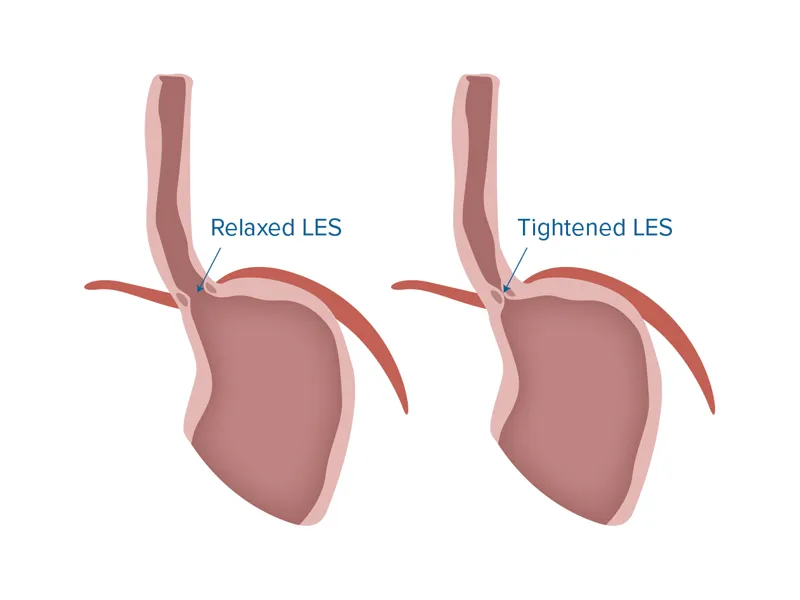
The Lower Esophageal Sphincter (LES) and Its Role in GERD
The lower esophageal sphincter (LES) is a ring of smooth muscle that connects the end of the esophagus with the start of the stomach. It acts as a one-way valve, allowing food and liquids to pass into the stomach while preventing stomach acid from flowing back up into the esophagus. This barrier is essential because the esophagus lacks the protective lining that the stomach has against acid. The LES operates involuntarily, controlled by your autonomic nervous system. When swallowing or belching, the LES relaxes (as shown in the first example on the left) and normally remains tight to stay closed otherwise (as shown in the second example on the right). When the LES does not function properly, stomach acid and partially digested food can reflux into the esophagus. If this backward flow occurs frequently or causes complications, it can develop into gastroesophageal reflux disease (GERD). Surgical interventions such as fundoplication can help restore its function by reinforcing the sphincter and reducing reflux.
Acid Reflux/GERD Tests and Treatments
-
Acid Reflux Measuring Tests
Doctors at the AdventHealth Digestive Health Institute use outpatient tests to measure Acid Reflux.
-
Endoscopic (Non-Surgical) Treatment for GERD
The experienced team at AdventHealth Digestive Health Institute offer effective treatment for GERD through non-surgical procedures. Learn more today.
-
Medications and Lifestyle Changes in Managing GERD
Surgeons at AdventHealth Digestive Health Institute offer Fundoplication to permanently treat GERD, Acid Reflux and Laryngopharyngeal Reflux.
-
Surgical Treatment for GERD
The AdventHealth Digestive Health Institute offers minimally invasive surgical options for patients with GERD. Learn more about our treatment options today.

Meet Your Dedicated Experts
Our specialists are passionate about providing collaborative care that addresses your unique needs and goals while ensuring you feel informed and supported every step of the way. Learn more about our team and their areas of expertise.
Conditions and Treatments
-
Achalasia
The experienced surgeons at AdventHealth Digestive Health Institute offer effective and permanent treatment for achalasia. Learn more about these treatment options.
-
Acid Reflux/GERD
AdventHealth Digestive Health Institute is a regional top provider of care for acid reflux: Gastroesophageal reflux disease (GERD) and laryngopharyngeal reflux.
-
Barrett's Esophagus
The gastroenterologists and surgeons at AdventHealth Digestive Health Institute provide leading-edge treatment for Barrett’s esophagus. Learn more today.
-
Esophageal Cancer
Typically esophageal cancer requires surgery in addition to radiation and chemotherapy. Learn more about the surgical treatments our specialists can provide.
-
Esophageal Surgery
At AdventHealth Digestive Health Institute, we offer minimally invasive, robotic esophageal surgery as a cancer treatment option.
-
Swallowing Disorders
Our board-certified speech pathologist can assist patients with swallowing disorders and voice issues.
-
Upper Endoscopy / Esophagogastroduodenoscopy (EGD)
An upper endoscopy helps doctors look at the esophagus, stomach and first part of the small intestine and can help diagnose a range of conditions.

Surgical Consultations For Digestive Cancer Without the Wait
Appointments Within Seven Days for Patients with Cancer
At AdventHealth Digestive Health Institute, we know that after being diagnosed with cancer, patients want and often need to begin treatment quickly. So we make it a priority to offer appointments for cancer surgery consultations within five business days, and often earlier.
Patients who are newly diagnosed with cancer, or have just found out they have cancer again, qualify for this priority access. Our surgeons will make themselves available to see you right away, even for a second opinion. We want to help you start your treatment as soon as possible.
Let Us Help You Feel Whole Again
Whether you’re experiencing new symptoms or want a second opinion on a diagnosis, our dedicated digestive health experts are here to help you find answers and a path forward. Request an appointment today to take charge of your health and get the personal support you need.